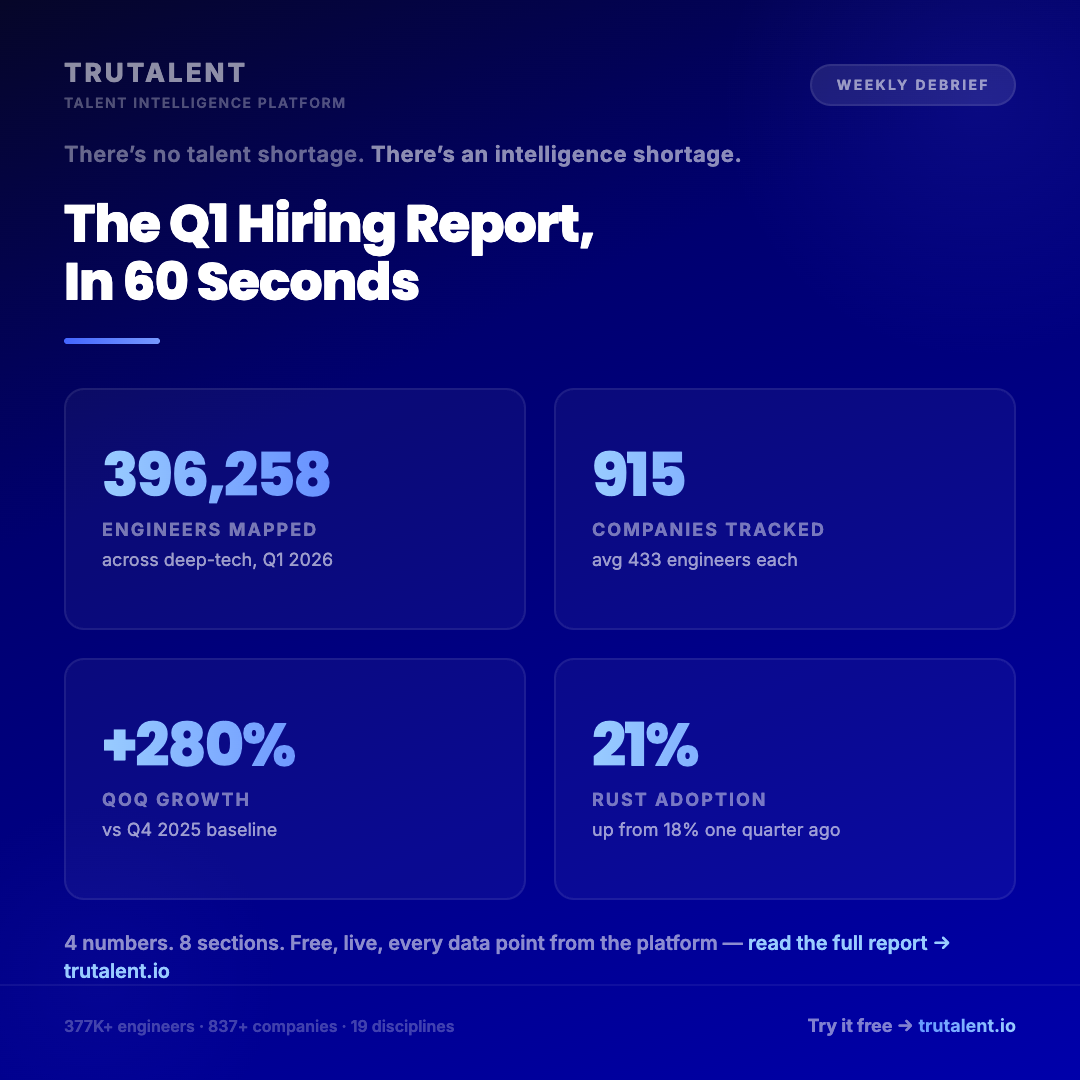
Four weeks ago we published the Q1 2026 State of Deep-Tech Talent Report. 396,258 engineers across 915 companies — +280% growth on Q4 2025. It’s the most comprehensive deep-tech talent map we’ve ever shipped, with sections on industry, geography, skills, trends, and what to do with the data.
If you read it, this edition is a refresher. If you didn’t, this is the 60-second version — designed to forward to your hiring manager before your next intake meeting. The full report is still live and still free.
4 numbers. 8 sections. Free, live, every data point from the platform.
The thesis: There’s no talent shortage. There’s an intelligence shortage. The next 60 seconds give you the proof — and 11 free market snapshots to act on it today.
Skip ahead: the full Q1 Report (8 sections, 5 trends, 5 strategic recommendations, free) is at trutalent.io/reports/q1-2026-deep-tech-talent.
Pull these into your next sourcing kick-off, hiring-manager intake, or quarterly review. Each one re-frames how big a deep-tech pool actually is.
396,258
Engineers mapped, +280% QoQ. Trutalent’s Q1 deep-tech pool across 915 companies. Roughly 13–20% of the estimated 2–3M global deep-tech engineering base.
191,000
Engineers in Hardware & Semiconductor — 31% of the entire pool. The deepest single sector, and the one most recruiters under-source because the slug “Hardware Engineer” only surfaces a third of it.
4 / 10
UK cities in the global top 10. London (~28K), Cambridge (~22K), Bristol (~9.5K), Edinburgh (~6.8K). Cambridge — population 150,000 — has more deep-tech engineers than Austin, Seattle, or Munich.
21%
Rust adoption: 18% → 21% in one quarter. Memory-safety mandates in defence and automotive are driving it. Not a niche skill anymore. The engineers writing Rust today are the engineers who’ll lead the platform-engineering teams of 2027.
58,000
Engineers in Aerospace & Defence — mostly clearance-locked. 37 companies. Security clearance + certification (DO-178C, ARP4754A, ISO 26262) gate the pool. The 17% in Automotive with transferable V&V skills is the adjacent pool most recruiters miss.
Five signals from the report’s skills section that are still moving the market 4 weeks on.
Rust21%, +3pp QoQ
Defence procurement language is starting to specify it. Strongest portable signal across silicon + embedded + systems-software roles. Sourcing tactic: filter for recent Rust commits on GitHub, not “Rust” on the CV.
CUDA16%, +4pp QoQ
Hardware engineers with GPU / AI exposure are the scarcest profile in the market. Most candidates aren’t applying — they’re being approached. Sourcing tactic: look in semiconductor + HPC research-lab teams, not “AI engineer” titles.
RISC-V + Open Silicon~11%, accelerating
Open-ISA work is portable career signal. OpenTitan, CHERIoT, Ibex contributors are the most cross-discipline-mobile engineers in the report — equally at home in semiconductor, defence, and hyperscaler.
DO-178C / ARP4754ASafety-critical
Cleared aerospace + defence engineers with current cert exposure command 3–6 month notice periods and 20–30% premium. Sourcing tactic: automotive functional-safety (ISO 26262) is the closest adjacent pool.
Linux Kernel + DriversBedrock skill
151 companies, 61,872 engineers across the lookup. Spans hyperscaler, defence, semiconductor, open-source. The most transferable skill in the report — same engineer ships in 4 different industries over a career.
The single recommendation from the Q1 Hiring Report most worth acting on: map before you search. Open the talent market for the role before the intake meeting. Walk in knowing the pool size, sub-sector concentration, city clusters, and cross-slug overlaps. Now the conversation with the hiring manager is about which segment of the pool to target — not whether the talent exists.
Most TA teams skip this step because mapping used to take a week. The Talent Market Lookup turns it into 30 seconds. Type the role title. Pool size + companies + industry breakdown render live, no sign-up. Take the screenshot. Bring it to the meeting.
The 4-step pre-intake routine
1
Open the lookup for the role title. Pool size + companies + industry breakdown render in 30 seconds. No login.
2
Note the sub-sector concentration. One slug, multiple sectors — identify the 2–3 biggest pools that match the hiring manager’s constraints.
3
Screen-share the result during the intake. Watch how fast the conversation shifts from “we can’t find anyone” to “we should look harder in [adjacent sub-sector]”.
4
Lock the segment, then write the brief. The brief stops being a wishlist; it becomes a sourcing plan with a known addressable pool. That conversation is the entire product.